DIY Car Safety: The Rules Before You Touch Anything
Posted by DIYCar Editorial Team Reviewed by DIYCar Editorial Team Review date Posted Topic: Oil and Basics
Before any DIY car job: read the owner's manual warnings, work on firm level ground, never get under a car held only by a jack, keep the engine off and the exhaust well ventilated, wear eye protection and gloves, handle fluids and batteries with care, and stop and use a shop whenever a job is safety-critical or beyond your tools.
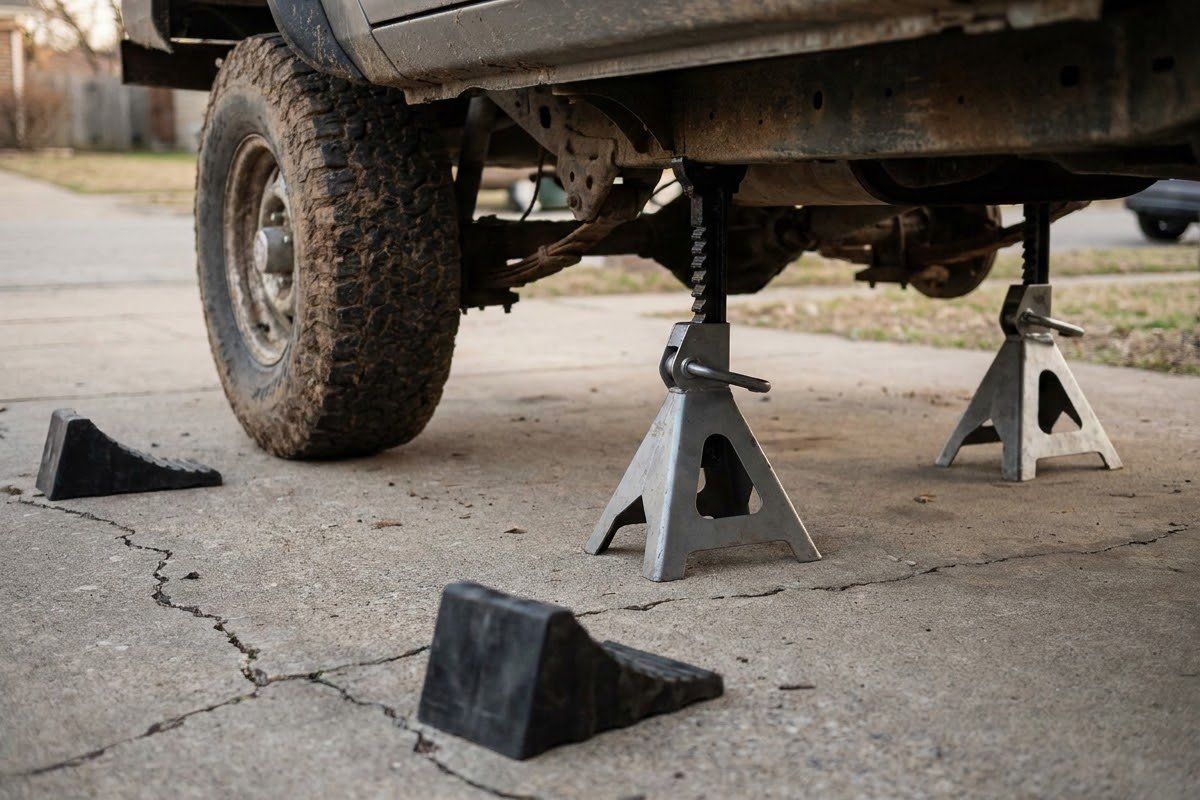
A few safety rules apply to almost every DIY car job. This page is the checklist to read before any guide on this site: the maintenance schedule overview and every how-to assumes you have. This guide is for gasoline passenger cars; for anything else, follow your owner’s manual.
The rules in one list
- Read the warnings in your owner’s manual for the job before you start.
- Park on firm, level ground. Never work on a slope.
- Never get under a car held only by a jack. Use jack stands or ramps (how to jack up a car safely).
- Switch the engine off and let it cool, unless the job needs it running.
- Wear eye protection and gloves.
- Work outdoors or somewhere well ventilated. Never run an engine in a closed garage.
- Keep sparks, flames and metal jewelry away from the battery.
- Collect and dispose of fluids correctly.
- If a step is beyond your tools, skill or the manual, stop.
Never work under a car held only by a jack
A jack lifts a car; stands hold it. One maker’s manual says: “Do not get under a vehicle that is supported by a jack,” and “Do not place any portion of your body under a vehicle that is only supported by a jack.” It also says to use vehicle support stands, to use the jack on firm level ground, to use the correct front and rear jacking positions, and not to let anyone stay in the vehicle while it is on the jack. The jack points are in your own manual.
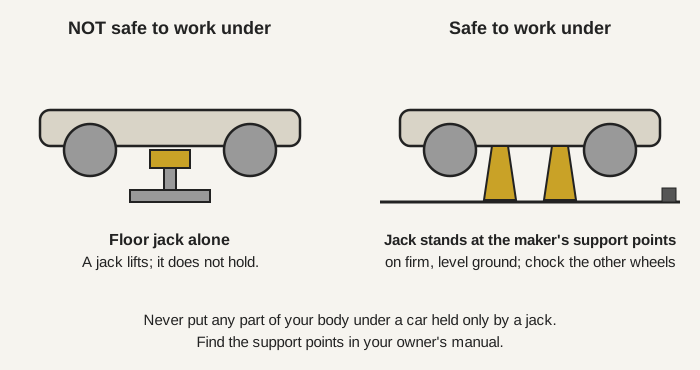
Read the full jacking guide before lifting anything.
Hot fluids and hot parts
Engine oil, coolant and the exhaust system can all be hot enough to burn. Let the engine cool before you open anything, and never open a hot coolant system. Work with your manual open, because it states where heat and pressure hazards are on your car.
Antifreeze and children and pets
Antifreeze contains ethylene glycol. CDC’s ATSDR notes that accidental ingestion can occur because antifreeze is a sweet-tasting, brightly colored liquid, and that exposure to large amounts can damage the kidneys, nervous system, lungs and heart. Clean spills at once, keep containers sealed and out of reach, and seek emergency help if anyone may have swallowed any.
Battery hazards
Your owner’s manual carries battery warnings for your car; read them before touching the battery. As a rule, keep flames and sparks away, take off rings and watches, and follow your manual’s order for disconnecting and connecting. Battery jobs have their own guide in this cluster, and the main one is how to replace a car battery.
Brakes are safety-critical
Your brakes are how the car stops. If a brake job goes wrong you may not find out until you need them. Read how to replace brake pads for what the job involves, and use a shop if your pedal is soft, the car pulls to one side, or anything feels uncertain.
Ventilation and carbon monoxide
Never run a car or truck inside a garage attached to a house, even with the garage door open. CDC says this, and adds that breathing in a lot of carbon monoxide can make you pass out or kill you; common signs are headache, dizziness, weakness, upset stomach, vomiting, chest pain and confusion. CDC says to open the door of a detached garage for fresh air when you run a vehicle in it, and to install battery-operated or battery back-up CO detectors near every sleeping area in your home.
Eye protection, gloves and other PPE
OSHA’s examples of personal protective equipment include gloves, safety glasses and shoes, earplugs or muffs, hard hats, respirators and coveralls. For a home car job, eye protection and gloves are the minimum. OSHA says eye and face protection is needed against chemical, environmental, radiological or mechanical irritants and hazards, and that work-related eye injuries could be prevented with proper selection and use of protection.
Dispose of fluids correctly
Used oil from one oil change can contaminate one million gallons of fresh water, says EPA, which advises collecting it in a leak-proof container and checking with local auto maintenance facilities, waste collectors and government waste officials for drop-off locations. Used oil filters should be drained and recycled too. For other fluids and batteries, ask your local waste authority.
When not to DIY
Stop and use a shop if:
- A brake job feels uncertain, the pedal is soft, or the car pulls.
- The check engine light is flashing, or the car has lost power.
- You smell fuel or see a fuel leak.
- The job involves airbags or the high-voltage parts of a hybrid or electric car.
- A fastener is stripped or seized.
- Your manual calls for a tool or software you do not have.
- You cannot support the car securely.
Useful next reads: the basic tool kit, the oil change walkthrough and the start here guide.
All Oil And Basics guides
- Basic Tool Kit for Car Maintenance: What a Beginner Needs
A beginner's tool kit for car maintenance: start with the manual and a tire gauge, then sockets, a torque wrench, stands and safety gear. Skip the rest.
- Car Maintenance Checklist: What to Check and When
A car maintenance checklist by system: what to check regularly, which jobs follow your manual's schedule, and which are safe for beginners to do.
- How Many Quarts of Oil Does My Car Need?
How many quarts of oil your car takes is listed in the owner's manual for your exact engine. Where to find it, and how to fill and check the level.
- How Often to Change Oil: What the Manual Says and Why
How often to change oil depends on your owner's manual, your driving conditions and the oil used. See normal vs severe schedules and what to check.
- How Often to Change Synthetic Oil (and What Changes vs Conventional)
How often to change synthetic oil is set by your owner's manual, not the label on the bottle. See what the oil type changes and what it does not.
- How to Change Oil in a Car: Step-by-Step for Beginners
How to change your own engine oil safely: the manual-first checks, the order of the job, used-oil disposal and when to hand the car to a shop.
- How to Jack Up a Car Safely: Jack Points, Stands and Ramps
How to jack up a car safely: use the manual's jack points, firm level ground, then support the car on jack stands or ramps before going under.
Quick answers
Is it safe to work under a car?
Only if the car is supported by jack stands or ramps rated for it, on firm level ground, using the jack points in your manual. One maker's manual says not to get under a vehicle supported by a jack and not to put any part of your body there. A jack lifts the car; it is not meant to hold it while you work underneath.
What PPE do I need?
At minimum, eye protection and gloves for most jobs. OSHA's examples of personal protective equipment include gloves, safety glasses and shoes, earplugs or muffs, hard hats, respirators and coveralls, and its eye and face protection page says protection is needed against chemical, environmental, radiological or mechanical irritants and hazards. Match the equipment to the hazard in the job's instructions and your manual.
Can I run the engine in a garage?
CDC says never to run a car or truck inside a garage attached to a house, even with the garage door open, because carbon monoxide can build up and can make you pass out or kill you. If the garage is detached, open the door for fresh air. If you can avoid running the engine indoors at all, do.
Is antifreeze dangerous to children and pets?
Yes. CDC's ATSDR notes that antifreeze is a sweet-tasting, brightly colored liquid and that accidental ingestion can occur, and that ethylene glycol in large amounts can damage the kidneys, nervous system, lungs and heart. Clean spills immediately, store coolant in its original sealed container out of reach, and seek emergency help if anyone may have swallowed it.
How do I dispose of used oil and fluids?
Put used oil in a leak-proof container and take it to a collection site; EPA says to check with local auto maintenance facilities, waste collectors and government waste officials for drop-off locations. Do not pour used fluids on the ground or down drains. EPA says used oil filters can usually go to the same collection centers. For antifreeze and batteries, ask your local waste authority; the EPA page we cite does not cover them.
When should I not do a job myself?
Hand the job to a shop if it involves brakes and anything feels wrong, if the car pulls or the pedal is soft, if the check engine light flashes, if you smell fuel, if you work near airbags or the high-voltage parts of a hybrid or electric car, if a fastener is stripped or seized, or if the manual calls for a tool or software you do not have.
Where we got this
- Kia Owner's Manual: Jacking instructions (ownersmanual.kia.com)
- CDC: About Carbon Monoxide (cdc.gov)
- ATSDR: Ethylene Glycol ToxFAQs (atsdr.cdc.gov)
- OSHA: Personal Protective Equipment (osha.gov)
- OSHA: Eye and Face Protection (osha.gov)
- EPA: Managing, Reusing, and Recycling Used Oil (epa.gov)
Further guides
- Car Maintenance Checklist: What to Check and When
A car maintenance checklist by system: what to check regularly, which jobs follow your manual's schedule, and which are safe for beginners to do.
- How to Change Oil in a Car: Step-by-Step for Beginners
How to change your own engine oil safely: the manual-first checks, the order of the job, used-oil disposal and when to hand the car to a shop.
- Basic Tool Kit for Car Maintenance: What a Beginner Needs
A beginner's tool kit for car maintenance: start with the manual and a tire gauge, then sockets, a torque wrench, stands and safety gear. Skip the rest.
- How Many Quarts of Oil Does My Car Need?
How many quarts of oil your car takes is listed in the owner's manual for your exact engine. Where to find it, and how to fill and check the level.
- How Often to Change Oil: What the Manual Says and Why
How often to change oil depends on your owner's manual, your driving conditions and the oil used. See normal vs severe schedules and what to check.
- How Often to Change Synthetic Oil (and What Changes vs Conventional)
How often to change synthetic oil is set by your owner's manual, not the label on the bottle. See what the oil type changes and what it does not.