How to Rotate Tires at Home Safely
Posted by DIYCar Editorial Team Reviewed by DIYCar Editorial Team Review date Posted Topic: Tires and brakes
To rotate tires at home, pick the pattern from your owner's manual, loosen the lug nuts while the car is on the ground, lift one end at a time at the manual's jack points, support the car on jack stands, swap the wheels, and tighten the lug nuts in a star pattern to the manual's torque. Never work under or beside a car held only by a jack.
Section of: How Often to Rotate Tires, and Why It Matters
Rotating tires at home is a manageable job if you do the safety steps first. The rotation interval guide explains when and why; this page covers how. Your owner’s manual decides the pattern, the jack points and the lug nut torque. Do not substitute numbers from anywhere else.
Before you start: jack stands, never just a jack
A jack lifts a car; it does not make it safe to be near. Use jack stands rated for your vehicle, set on level hard ground, with the parking brake on, the car in park or in gear, and wheels chocked. Never get under or reach into a car held only by a jack. Wear eye protection; OSHA’s workplace standard names flying particles and chemicals as eye hazards. Read the jack safety guide and the safety guide first.
Pick the pattern
Michelin describes the common patterns: front-wheel drive moves the front tires straight back and crosses the rear tires forward; rear-wheel drive does the reverse; all-wheel drive typically uses a crisscross unless the maker says otherwise. Directional tires stay on the same side and move front to rear only. Use the tire rotation pattern tool and confirm in your manual.
Step by step
- Park on level, hard ground, set the parking brake and chock the wheels that stay on the ground.
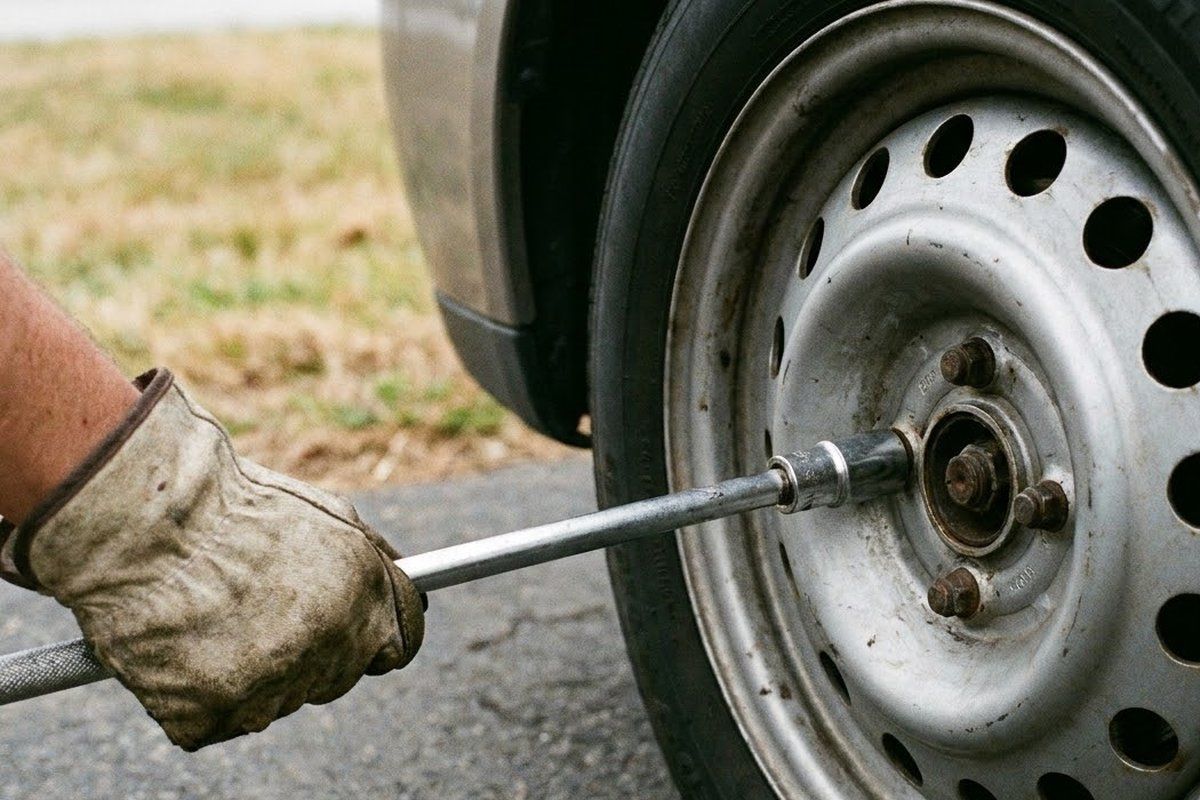
- Loosen the lug nuts about a half turn on each wheel while the car is still on the ground. Do not remove them yet.
- Lift one end at a time using the jack points shown in your manual, then place jack stands under the manual’s support points.
- Remove the wheels and set them aside, noting each position.
- Move each wheel to its new position following your pattern.
- Hand-thread the lug nuts to seat them evenly, then lower the car until the tires touch the ground.
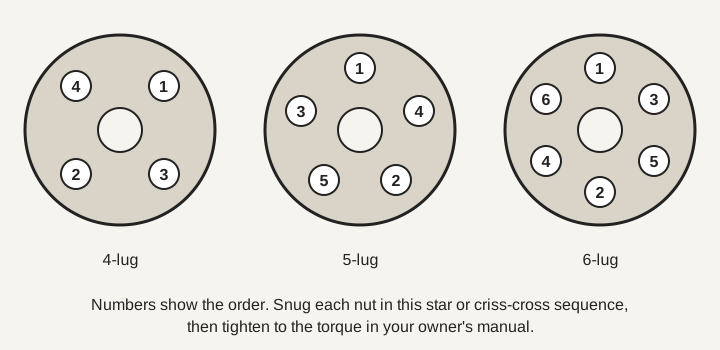
- Tighten in a star pattern with a torque wrench to the value in your manual.
- Repeat for the other end if you lifted only one.
- Set tire pressure to the door-jamb sticker value.
- Re-check the torque after a short drive, as your manual advises.
Re-check torque after a short drive
Some manuals call for a re-check after a short drive; look for the distance in yours. Use the torque wrench again; if a nut moves before the wrench clicks, tighten to spec and re-check soon. Never drive far on wheels you have not torqued.
Set tire pressure
fueleconomy.gov says the correct pressure is usually on a sticker in the driver’s door jamb or glove box and in your manual, and not the maximum printed on the sidewall. Properly inflated tires are safer and last longer.
Reset TPMS if the manual says to
Your manual says whether the tire pressure monitoring system needs a reset after rotation. Follow it exactly. If the warning light stays on, have a shop check the system.
Stop and use a shop if
- You do not have jack stands, a torque wrench or level hard ground.
- Your tires are directional, staggered or run-flat and the manual is unclear.
- A lug nut, stud or wheel is stuck, stripped or damaged.
- A locking wheel nut key is missing.
- You find damage, a bulge or a brake problem while the wheel is off.
- You are not sure the car is secure on its stands.
Quick answers
Can I rotate tires without a jack?
No. To move a wheel you must lift the corner of the car, and that needs a jack plus jack stands rated for the vehicle. Work from the lifting points in your owner's manual on level, hard ground. If you do not have stands, do not improvise with blocks or a jack alone; have a tire shop with a lift do the rotation.
How long does it take to rotate tires?
We do not give a time because it depends on your tools, your car and how many checks you make. Plan an unhurried session. Rushing is how lug nuts get skipped or torque is missed. If you are new to the job, treat the first rotation as a practice run with the manual open and no deadline.
Do I need a torque wrench to rotate tires?
Yes, for a correct result. Your owner's manual gives a lug nut torque, and the only way to meet it is with a torque wrench. An impact wrench can easily over-tighten nuts, so it is not a substitute for the torque wrench. Use one only to run nuts on lightly, then finish with the torque wrench in a star pattern.
Should I re-check the lug nuts after rotating?
Follow your owner's manual, which may call for a re-check after a short drive. Look for the distance in it, and use the torque wrench again. If a nut turns before it clicks, tighten to the specified torque and re-check again soon. Never drive far with a wheel you have not torqued.
Do I need to reset the tire pressure monitoring system?
Only if your manual says so. Some vehicles need a reset procedure or a relearn after tires are moved or after pressure is changed, and others do not. Set the pressure to the value on the driver's door-jamb sticker, then follow the TPMS section of your manual. If a warning light stays on, have a shop check it.
What if a lug nut or wheel is stuck?
Stop and use a shop. Do not hammer, use a long pipe on the wrench or force a wheel. Rust, a seized or stripped stud, or a locking wheel nut without its key can turn a simple job into a damaged wheel. A tire shop has the tools to free it safely.
Where we got this
- Michelin: Tire rotation (michelinman.com)
- U.S. Department of Energy, fueleconomy.gov: Maintenance and tire pressure (fueleconomy.gov)
- OSHA: 29 CFR 1926.102, Eye and face protection (osha.gov)
Further guides
- Brake Pads Explained: Types, Wear Signs and When to Replace
What brake pads do, the wear signs to watch (squeal, grinding, thin pads), ceramic vs semi-metallic types and when to see a shop instead of DIY.
- How Often to Rotate Tires, and Why It Matters
How often to rotate tires: follow your owner's manual, with Michelin's 5,000 to 7,000 mile guide as a fallback. Patterns by drivetrain and exceptions.
- Brake Pad Thickness: How to Check It and the Minimum
Brake pad thickness: how to look through the wheel, what Wagner says about 1/4 inch and the wear slot, and why your car's own minimum counts.
- How to Replace Brake Pads: What the Job Involves and When to Call a Shop
What replacing brake pads involves, tools, a step-by-step overview, bed-in, low-speed testing and a clear list of when to leave the job to a shop.