How to Jump-Start a Car Safely
Posted by DIYCar Editorial Team Reviewed by DIYCar Editorial Team Review date Posted Topic: Battery
To jump-start a car, first read the jump-starting section of your owner's manual, because the cable order and connection points are the maker's to set. Never jump a frozen or damaged battery, wear eye protection, keep flames and sparks away, and never let the clamps touch each other. If the car will not start after a try or two, stop and call for help.
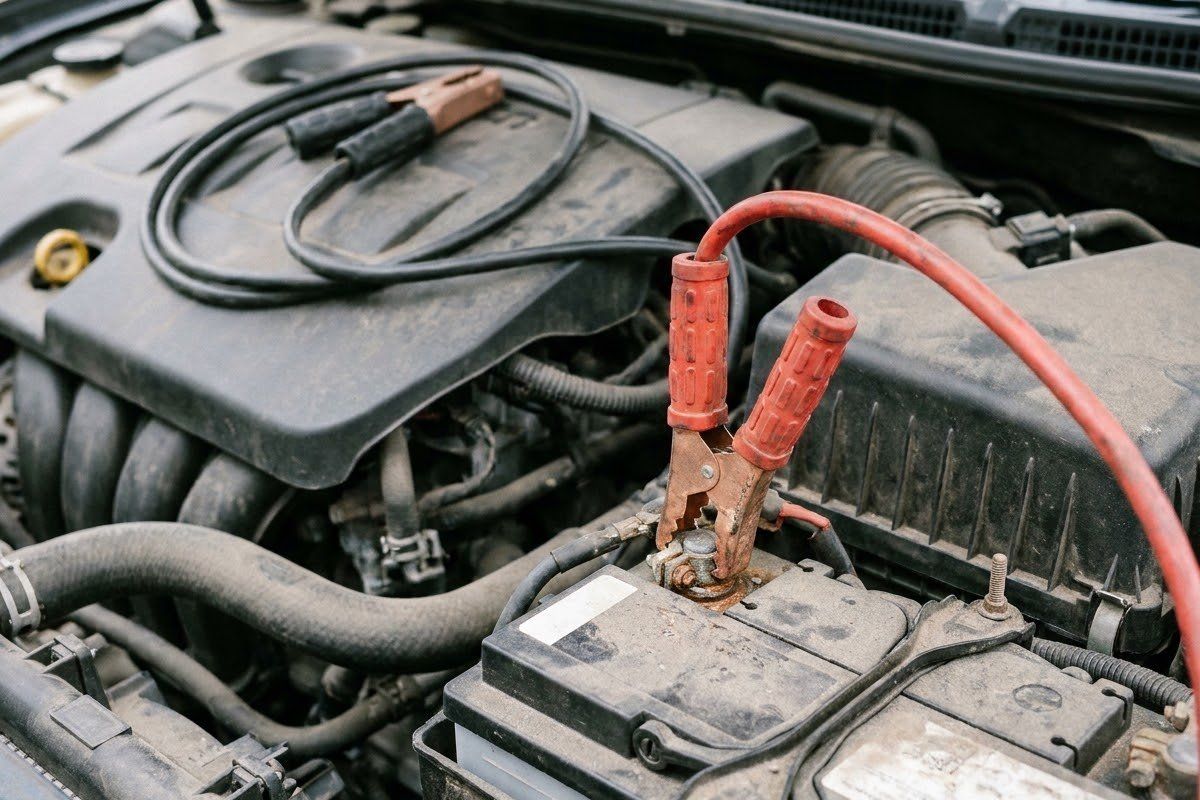
Section of: How to Replace a Car Battery Safely, Step by Step
A jump start is a short, high-current job near a battery that can give off explosive gas. This guide covers when not to attempt it, how to prepare and the general order, cross-checked against the Kia, Mazda, Hyundai and Ford owner’s manuals. Your own owner’s manual decides the exact steps. If the battery keeps dying, the battery replacement guide covers the next move.
When not to jump-start
Do not jump-start a frozen battery, one with a low electrolyte level, or one that is cracked, leaking or swollen. The Kia manual we cite says a battery may rupture or explode when jump-started with a low or frozen battery, and Mazda’s and Hyundai’s manuals say the same about a frozen battery. Kia also warns never to check a battery’s electrolyte level, for the same reason. A cracked, leaking or swollen case is our own caution: do not connect anything to it.
Stop and call roadside help or a shop if:
- you see a cracked case, a bulge, leaking fluid or heavy corrosion;
- the car has a hybrid or stop-start system and the manual does not describe jump starting;
- you smell burning or see smoke near the battery;
- you cannot tell which cable goes where, or the manual is not available (the Kia manual strongly recommends a competent technician or towing service if you are unsure);
- the car is stopped in traffic, where you cannot work safely.
What you need
- A 12-volt booster: a second car with a healthy 12-volt battery, or a 12-volt jump pack. The manual we cite says to use only a 12-volt jumper system, and not a 24-volt supply such as two 12-volt batteries in series, because that can damage the starter, ignition system and other electrical parts beyond repair.
- Jumper cables in good condition, with no frayed insulation or loose clamps.
- Eye protection. The manual says to wear protective glasses and be careful not to get acid on yourself, your clothing or the vehicle.
- Your owner’s manual, open to the emergency starting section.
Prepare both vehicles
- Park so the cables reach, but keep the two vehicles from touching. The manual makes this a condition of the procedure.
- Switch both cars off and turn off unnecessary electrical loads, such as lights and the climate system.
- Check the booster battery is 12-volt and its negative terminal is grounded, as the manual states.
- Keep flames, cigarettes and sparks away. The manual says the battery produces hydrogen gas that may explode if exposed to flame or sparks.
- Do not lean over the battery while connecting cables.
Connect the cables in order
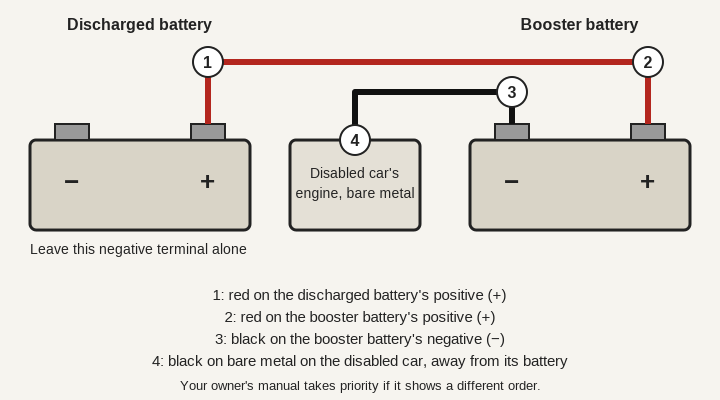
This is the sequence in the Kia manual we cite. The Ford, Mazda and Hyundai manuals we checked follow the same pattern: positive to positive, then the booster’s negative, and the last clamp to bare metal or a ground point on the disabled car, away from the battery. Your manual’s illustration and wording take priority.
- One end of the first cable on the positive terminal of the discharged battery.
- The other end of that cable on the positive terminal of the booster battery.
- One end of the second cable on the negative terminal of the booster battery.
- The other end of the second cable on a solid, stationary metal point away from the battery, such as the engine lifting bracket, and not on a part that moves when the engine cranks.
Do not let the positive and negative clamps touch each other; Kia and Hyundai say this can cause sparks. Kia also says not to connect the booster’s negative cable to the negative terminal of the discharged battery, because that can overheat and crack the discharged battery and release acid. Mazda and Hyundai give the same warning.
Start the engines
Start the booster vehicle’s engine, then the vehicle with the discharged battery. The Kia manual we cite says to run the booster at 2,000 rpm while you start the other car; Ford says to rev it at a moderately high speed. A jump pack’s instructions may differ, so follow them if you use one. If the engine does not start after a couple of tries, stop and call for help rather than cranking repeatedly. That limit is our caution, not a figure from a manual.
Disconnect in reverse
Ford says to run both vehicles for three more minutes before disconnecting, and not to switch the headlamps on while you disconnect. Then remove the cables in the exact reverse of the order you connected them (Ford, Mazda and Hyundai all say this): the ground clamp first, then the booster’s negative, then the booster’s positive, then the positive on the formerly discharged battery. Keep the clamps apart as you remove them.
After the car starts
- Follow your manual on what to do next. If you are unsure the car will restart, keep it running until you reach a safe place to have the battery tested.
- Find out why the battery went flat. A light left on explains it; an old battery or an unknown cause does not. The manual we cite says that if the cause of the discharge is unclear, a professional workshop should check the system.
- Have the battery tested. If it goes flat again, ask a shop to test it; a full charge with a charger may be an option, and a battery that will not hold a charge needs replacing. Related: what size battery your car needs and AGM versus flooded types. For a car that sits, see trickle chargers and battery maintainers, and for the old battery, see taking it back for recycling.
Common mistakes
- Using the dead battery’s negative terminal for the final connection.
- Letting the clamps touch while one end is connected.
- Connecting in a hurry without the manual, which may show different jump points on your car.
- Trying to jump a battery that is frozen or visibly damaged.
- Treating a jump start as a repair. It only moves the problem somewhere safer.
For general job safety, see our safety basics, and add battery checks to your routine.
This guide is for gasoline passenger cars. Diesel vehicles differ; see your manual.
Quick answers
Which cable do I connect first when jump-starting a car?
Follow your owner's manual. The manual we cite starts with one end of the first cable on the discharged battery's positive terminal, then the other end on the booster battery's positive terminal. The Ford, Mazda and Hyundai manuals we checked say the cables come off in the exact reverse order. If your manual shows a different sequence, use the manual's.
Where does the last clamp go?
The manual we cite says the final clamp goes to a solid, stationary metal point away from the battery, such as the engine lifting bracket, and never to a part that moves when the engine cranks. It also says not to connect the booster's negative cable to the discharged battery's negative terminal. Your manual names the right point for your car.
Can I jump-start a frozen battery?
No. The manual we cite says not to jump start when the discharged battery is frozen or its electrolyte level is low, because the battery may rupture or explode. Do not try to warm it up and jump it anyway. Have a shop or roadside service look at it, and replace it if it is damaged.
Can I use a jump pack instead of a second car?
Maybe. A portable jump pack has its own instructions, and your owner's manual may also say what is allowed. Use only a 12-volt unit, read the pack's instructions before connecting anything, and follow the order they give. If the instructions and the car's manual disagree, call a roadside service rather than guessing.
The car will not start after jumping. What now?
Stop after a couple of attempts rather than cranking repeatedly. The battery may be worn out, or something else is wrong, such as the charging system or a connection. The manual we cite says that if the cause of the discharge is unclear, a professional workshop should check the system. Call roadside help or a shop.
Is it safe to jump-start a hybrid or a car with stop-start?
Only if the owner's manual says so and shows where to connect. Many modern cars have special jump points or procedures, and some should be jumped only by a shop. The manual's emergency starting section is the authority. If your manual says nothing, or you cannot find it, call roadside assistance instead of connecting cables.
Where we got this
- Kia owner's manual: Jump starting (Emergency starting) (ownersmanual.kia.com)
- Mazda owner's manual: Jump-starting (mazdausa.com)
- Hyundai owner's manual: Jump starting (ownersmanual.hyundai.com)
- Ford owner's manual: Jump starting the vehicle (fordservicecontent.com)
Further guides
- How to Replace a Car Battery Safely, Step by Step
Replace a car battery safely: hazards, group size, disconnect and reconnect order, cleaning terminals, recycling the old one and when to see a pro.
- Car Battery Replacement Cost: What Drives the Price
What decides car battery replacement cost: size, chemistry, labor, return credits and warranty, plus a checklist for comparing quotes. No made-up prices.
- Car Battery Types: AGM vs Flooded vs EFB, Explained
Compare flooded, EFB and AGM car batteries: how each is built, what group size, CCA and reserve capacity mean, and where to find your car's required type.
- How to Charge a Car Battery Safely With a Charger
Charge a car battery safely with a charger: ventilation, clamp order, charger settings, how to tell it is done, and when the battery is beyond saving.